

Weekly Market Insight
Welcome to our weekly market update. This newsletter is designed to provide you with current market data, investment insights, and educational information about market trends and strategies. The content herein represents our observations and analysis of market conditions and is intended for informational and educational purposes only. It does not constitute personalized investment advice or a recommendation for any specific security or strategy.
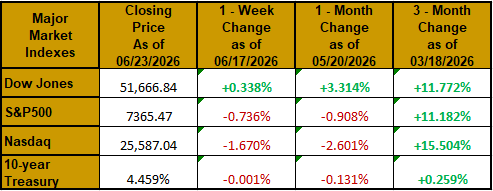
Major Market Indexes
Closing Price as of 06/23/2026
The Strong Tower Difference
Ask Yourself…
What do you own?
Why do you own what you own?
Do you know what you’re truly paying for your investment management and advice?
If you can’t answer these three questions, watch this video
Items of Interest
Odds and Ends (From various news outlets)
The Last 7 Days:
1. Federal Reserve Remains the Primary Market Driver
The Federal Reserve left interest rates unchanged at 3.50%–3.75%, but markets interpreted recent comments from new Fed Chair Kevin Warsh as more hawkish than expected. Treasury yields moved higher as investors reassessed the possibility of additional rate hikes rather than cuts later this year. This has pressured high-growth and technology stocks. (JP Morgan Asset Mgmt).
2. Technology Stocks Experience Sharp Pullback
After months of AI-driven leadership, technology and semiconductor stocks suffered a significant selloff this week.
Key developments:
The Nasdaq 100 lost more than $1 trillion in market value during the decline.
Semiconductor stocks fell sharply, with investors questioning the pace of AI spending and future returns on massive infrastructure investments.
Nvidia, Micron, and other AI-related names were among the largest drags on the market. (Reuters)
3. Middle East Tensions Ease, Helping Risk Assets
One of the biggest geopolitical developments was continued progress toward a ceasefire and stabilization between the U.S. and Iran. Reduced fears of supply disruptions in the Strait of Hormuz helped calm energy markets and improve investor sentiment.
The easing of tensions:
Reduced concerns about oil supply shocks.
Lowered immediate inflation fears.
Supported broader equity markets despite the technology correction. (tradingKey.com)
4. Oil Prices Stabilize
Earlier concerns that Middle East conflict could push oil above $100 per barrel have diminished as ceasefire efforts gained traction. Energy markets remain sensitive, but traders have become less concerned about a major disruption to global oil supplies. (tradingkey.com)
5. Stocks Still Near Record Highs
Despite recent volatility:
The S&P 500 remains near all-time highs.
The market is still enjoying one of its strongest quarters in several years.
Momentum remains positive, although leadership has become narrower and more concentrated in a handful of large-cap stocks. (The Life Financial Group)
What Markets Could Be Watching Next
Bullish Factors:
Markets continue to be supported by apparent lessening of Middle East tensions, solid corporate earnings, continuing investment in artificial intelligence, and a consumer that continues to spend despite higher interest rates.
Key Risks:
Investors remain cautious about rising Treasury yields, a more hawkish Federal Reserve, concerns that AI-related spending may slow, and the potential for renewed geopolitical tensions in the Middle East.
The market’s outlook remains positive, but future gains will likely depend on whether economic growth and earnings can continue to offset higher interest rates and geopolitical risk.
Questions from a Client
“Do We Need to Be More Diversified as We Get Older?”
This question has come up recently, especially after several years of strong market returns and periods of volatility driven by tariffs, geopolitical conflicts, and economic uncertainty.
My response began with two questions:
1. Are you comfortable with the investment process being used to manage your portfolio?
If the answer is Yes, then proceed to my second question.
If the answer is No, let’s talk!
2. If something were to happen to you, who would ultimately receive these assets?
For most clients, the answer is a spouse, children, or other heirs. When viewed through that lens, it is worth considering whether those future beneficiaries could benefit from the same long-term growth-oriented investment strategy that helped build the portfolio in the first place.
While age is certainly a factor in financial planning, it is not the only consideration. Income needs, risk tolerance, estate planning objectives, overall assets, and time horizons all play important roles in determining an appropriate investment strategy.
Markets will always face challenges and uncertainty. Headlines change, geopolitical events come up unexpectedly, and volatility is a normal part of investing. Rather than reacting emotionally to events beyond our control, we believe in remaining disciplined, staying engaged, and focusing on the process.
At Strong Tower, our approach is to stay vigilant, evaluate opportunities and risks as they develop, and make adjustments when necessary. Long-term investing often requires patience, perspective, and the ability to remain focused on what matters most.
Stay the course. Stay engaged. Stay focused on your goals. Let Strong Tower execute. Have a blessed day.
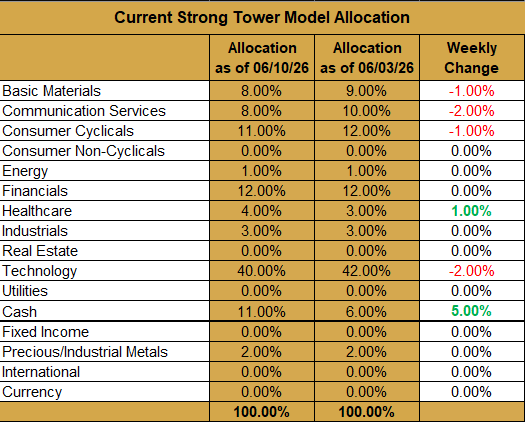
Current Strong Tower Model Allocation
Clients Only — Allocation as of 06/23/2026
Bottom Line:
55.00% of our model is currently in the top 4 Industry Groups.
85.00% of our model is currently in the top 8 Industry Groups.
About Us
At Strong Tower Wealth Management, we offer comprehensive wealth management services using a goal-focused and holistic approach that considers each client’s overall financial situation, including their family, circumstances, and objectives. Our services include investment management, insurance planning, and estate planning coordination, provided with an emphasis on clarity and transparency.
Not a client yet? We invite you to schedule an introductory assessment with Brett to discuss your financial goals and learn more about how we can support you.
Brett Lewis
Founder / Managing Director
Strong Tower Wealth Management
www.strongtowerwealthmanagement.com