

Weekly Market Insight
Welcome to our weekly market update. This newsletter is designed to provide you with current market data, investment insights, and educational information about market trends and strategies. The content herein represents our observations and analysis of market conditions and is intended for informational and educational purposes only. It does not constitute personalized investment advice or a recommendation for any specific security or strategy.
Major Market Indexes
Closing Price as of 08/18/2026

The Strong Tower Difference
Ask Yourself…
What do you own?
Why do you own what you own?
Do you know what you’re truly paying for your investment management and advice?
If you can’t answer these three questions, watch this video
Items of Interest
Not Everyone Does and Should Get a Trophy
The Role of Hard Work in Life, Career, and Sports
There is a comforting idea that if we participate, make an effort, and keep showing up, eventually we will receive the reward we desire. Participation trophies can serve a legitimate purpose, particularly for children learning the value of joining a team, trying something new, and honoring a commitment. But life eventually teaches a harder lesson: participation is not achievement, effort is not excellence, and wanting something is not the same as earning it.
In life, careers, and sports, not everyone gets a trophy. Not everyone reaches the goal. And sometimes the reason is uncomfortable but simple: We did not want the goal badly enough to do the work required to pursue it.
That does not mean hard work guarantees success. It does not. But refusing to do the necessary work can dramatically reduce the chances of achieving what we say we want.
Wanting the Result Is Different from Wanting the Work
Most people want desirable outcomes. Athletes want championships. Employees want promotions. Entrepreneurs want successful businesses. Students want good grades. Families want financial security. People want to be healthy, respected, accomplished, and independent.
But wanting the outcome is easy.
The more important question is: Do you want what is required to pursue it?
An athlete may want to start every game but not want the early workouts, repetitive drills, disciplined diet, painful conditioning, critique from coaches, or hours spent improving on weaknesses.
An employee may want the promotion but not want the additional responsibility, education, preparation, difficult conversations, longer hours, or accountability that comes with becoming qualified for it.
A person may want financial independence but be unwilling to control spending, delay gratification, increase earnings, save consistently, or make difficult financial decisions over many years.
In each case, the desire for the reward is real. But desire alone produces very little.
Goals have a price
Sometimes that price is time. Sometimes it is discipline, discomfort, sacrifice, patience, humility, or repeated failure. Often it is all of them. We do not necessarily get what we want. We frequently get something closer to what our choices, habits, preparation, circumstances, and abilities produce.
Sports Make the Lesson Obvious
Sports provide one of the clearest demonstrations of this principle. Two teams can both practice hard. Both can prepare. Both can desperately want to win.
One still loses.
An athlete can spend years training for the Olympics and miss qualifying by a fraction of a second. A golfer can practice thousands of hours and never make the professional tour. A talented high-school athlete can dedicate himself to his sport and never receive the scholarship he hoped for.
Hard work matters enormously, but hard work does not assure victory.
Talent matters. Coaching matters. Genetics matter. Resources matter. Competition matters. Health matters. Timing matters. Opportunity matters. And sometimes plain luck matters.
An injury can end a season.
A superior opponent can appear at exactly the wrong time.
A referee can make a questionable call.
A ball can bounce the wrong direction.
A better player at your position may come along and beat you out.
You can do many things correctly and still lose an opportunity.
None of those things meant the work was worthless. They mean the world does not promise outcomes in exchange for effort.
The mature response is not to conclude that effort does not matter. It is to recognize the distinction between what increases the probability of success and what guarantees success.
Very little guarantees success.
Hard work simply improves the odds.
Sports teach us that we can control preparation far more than we can control results.
That is one of their greatest lessons.
Sometimes We Have to Admit We Didn’t Work Hard Enough
There is another side to this discussion that is easier to avoid.
Sometimes circumstances did not defeat us.
Sometimes we defeated ourselves.
We procrastinated. We were inconsistent. We wanted comfort more than improvement. We ignored advice. We refused to practice the things we were bad at. We made excuses.
We expected recognition before producing results. We quit when the work became monotonous.
It is tempting in those moments to blame circumstances, other people, unfair systems, bad luck, coaches, employers, teachers, competitors, or society.
Sometimes those explanations are legitimate.
Sometimes they are excuses.
Personal growth requires enough honesty to know the difference.
There is no shame in discovering that you were unwilling to pay the price for a particular goal. The goal may not have been important enough to you. Perhaps the sacrifice was greater than the reward.
Perhaps your priorities changed and as a result, so did your attitude.
But there is value in saying so honestly.
“I wanted it, but I wasn’t willing to do what it required” is very different from saying, “I deserved it because I wanted it.”
Hard Work is Necessary...But it is Not Magic
The phrase “work hard and you can accomplish anything” is inspirational, but taken literally, it is not true.
There are limits.
A baseball player can train relentlessly and still be unlikely to become an MLB starting short stop. A musician can practice diligently without becoming a world-famous performer. A business owner can make intelligent decisions and still encounter a recession, disruptive competitor, regulatory change, or unexpected crisis.
Reality places constraints on ambition.
Recognizing those constraints is not pessimism. It is maturity.
Hard work should therefore be understood for what it actually provides: Opportunity, improvement, resilience, competence, and better probabilities, not certainty.
That distinction matters.
If hard work guaranteed success, every hardworking person would be wealthy, every dedicated athlete would be a champion, and every conscientious employee would become an executive.
Clearly, that is not how the world operates.
What We Can Control
We cannot control every outcome, but we have considerable influence over “the person” who enters the competition.
We can control whether we prepare.
We can control whether we practice.
We can control whether we learn.
We can control whether we accept criticism.
We can control whether we keep our commitments.
We can control whether we improve our weaknesses.
We can control how we respond when circumstances go against us.
And perhaps most importantly, we can control whether we are honest with ourselves about the effort we actually gave.
There is an enormous difference between saying “I tried” and being able to say, “I did everything I could, within my control.”
The second statement carries THE most weight.
Losing Is Not the Same as Failing
If hard work does not guarantee success, then we also need a better definition of failure.
Losing is an outcome.
Failure can be something different.
An athlete who gives everything, prepares properly, competes honorably, and loses to a better athlete, has lost the contest. That does not necessarily make the experience a failure.
An entrepreneur who builds a business responsibly and watches it fail because circumstances change, may lose money without losing the knowledge, discipline, and judgment acquired through the experience.
An employee who develops new skills and competes for a promotion, may not get the position, but may emerge considerably more valuable than before.
The trophy is not always the point.
Sometimes the reward is becoming more capable because you pursued something difficult.
Life Does Not Owe Us the Outcome
Perhaps the most important lesson is also the simplest:
Life does not owe us the result we desire merely because we participated.
Showing up matters.
Involvement matters.
Effort matters.
Hard work matters.
But achievement requires more.
It requires preparation, discipline, persistence, ability, judgment, opportunity, and circumstances, and even when many of those things come together, success can remain uncertain.
That uncertainty is not a reason to stop trying.
It is precisely what gives achievement meaning.
A trophy has value because it represents something that was not guaranteed.
A promotion matters because it had to be earned.
A championship matters because someone could lose.
A difficult goal matters because failure was possible.
The lesson should therefore be neither “everyone deserves a trophy” nor “hard work guarantees a trophy.”
The better lesson is this:
Decide what you want. Understand what it requires. Work harder and smarter than your goal demands. Accept that some factors will always remain beyond your control. And when the outcome arrives, victory or defeat, have the courage to evaluate yourself honestly.
Sometimes you will work hard and win.
Sometimes you will work hard and lose.
Sometimes you will have to admit that you did not work hard enough.
But if you learn to distinguish between effort, entitlement, achievement, and circumstances beyond your control, you gain something more useful than a participation trophy:
You learn how to compete with life on life’s terms.
Last Thought:
We can never work hard enough, live well enough, or accomplish enough to earn God’s grace and mercy. They are gifts, freely given through Christ. Yet grace is not an excuse to stop trying; it is the reason we keep trying.
“For by grace are we saved through faith; and that not of yourselves: it is a gift of God: Not of works, lest any man should boast.” Ephesians 2:8-9 King James Version
That may be the larger lesson for life, as well. We strive without believing we are entitled to the outcome. We work without believing our work makes us worthy. We persevere knowing that we will sometimes fall short.
God does not ask us to earn His grace. We cannot. He asks us to receive it, and then to live differently because we have received it.
Grace is not the trophy we receive for trying hard enough. Grace is the gift we could never earn. And perhaps one of the greatest ways we honor that gift is to keep showing up, keep striving, keep trying. Not to earn God’s love. HE has already freely given it and done all the heavy lifting…............
Grace and Peace go with you all today!
The Last 7 Days.
3 Main Themes:
1) Middle East / oil is the biggest risk. U.S.–Iran tensions remain unresolved and disruption around the Strait of Hormuz is keeping oil elevated. Higher energy prices threaten to push inflation and Treasury yields higher, which is the clearest near-term threat to stocks. (Barron’s)
2) The U.S. economy is cooling. Inflation eased to 3.4%, reducing pressure on the Fed to raise rates immediately. At the same time, weaker consumer and employment data suggest economic growth is slowing. For now, markets view this as relatively positive because it could keep the Fed on hold. (Financial Times)
3) AI is still supporting stocks, but enthusiasm is cooling. Strong AI-related earnings helped keep markets near records earlier in the week, but AI and semiconductor stocks have since pulled back as investors question valuations and the returns on massive AI spending. (AP News)
Bottom Line:
The market is caught between good fundamentals/cooling inflation and rising geopolitical, oil and interest-rate risks. Stocks remain close to record highs, but the risk/reward has become less comfortable.
Things to watch: Oil/ Hormuz, Treasury yields/Fed, consumer weakness and AI earnings. These 4 factors may suggest whether this remains a normal pullback or develops into something more significant.
Have a blessed day!
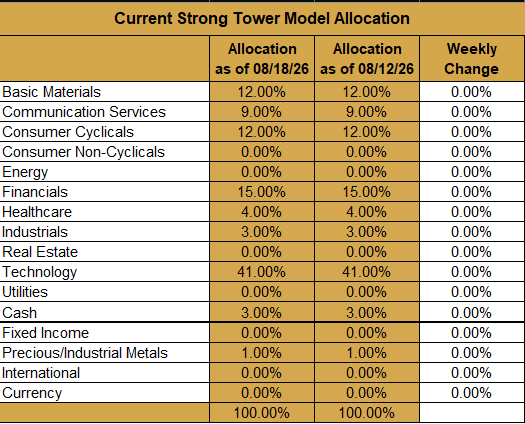
Current Strong Tower Model Allocation
Clients Only — Allocation as of 08/18/2026
Bottom Line:
64.00% of our model is currently in the top 4 Industry Groups.
83.00% of our model is currently in the top 8 Industry Groups.
About Us
At Strong Tower Wealth Management, we offer comprehensive wealth management services using a goal-focused and holistic approach that considers each client’s overall financial situation, including their family, circumstances, and objectives. Our services include investment management, insurance planning, and estate planning coordination, provided with an emphasis on clarity and transparency.
Not a client yet? We invite you to schedule an introductory assessment with Brett to discuss your financial goals and learn more about how we can support you.
Brett Lewis
Founder / Managing Director
Strong Tower Wealth Management
www.strongtowerwealthmanagement.com