

Weekly Market Insight
Welcome to our weekly market update. This newsletter is designed to provide you with current market data, investment insights, and educational information about market trends and strategies. The content herein represents our observations and analysis of market conditions and is intended for informational and educational purposes only. It does not constitute personalized investment advice or a recommendation for any specific security or strategy.
Major Market Indexes
Closing Price as of 01/13/2026

The Strong Tower Difference
Ask Yourself…
What do you own?
Why do you own what you own?
Do you know what you’re truly paying for your investment management and advice?
If you can’t answer these three questions, watch this video.
2. Why Do You Own, What You Own?
Whether you are new to investing, currently investing, or evaluating how your retirement assets are managed, it is important to understand the different investment strategies and options available. Below, we will take a closer look at a couple of commonly used approaches to help provide context around how portfolios may be constructed and managed.
Current Items of Interest
Re-Balancing
You have probably heard the term “rebalancing” mentioned in conversations with a financial advisor. It is often described as something that occurs periodically, annually or at set intervals with the intent of rearranging or reallocating an investment portfolio.
Rebalancing is commonly defined as:
Realigning investments back to an intended target allocation over time.
Trimming positions that have grown larger and reallocating to those that have lagged. Maintaining alignment with a predefined investment plan.
These definitions are widely accepted within the investment industry. The natural follow-up question, however, is why this approach is used.
Why rebalance at all?
Traditional rebalancing is generally intended to:
Maintain a consistent risk profile.
Prevent portfolio allocations from “drifting” too far from their original design.
Enforce a disciplined, rules-based approach.
This framework can be appropriate for many investors, particularly those focused on long-term asset allocation and risk control. However, it also assumes that all asset classes should be maintained regardless of relative performance or market conditions.
A different perspective:
At Strong Tower Wealth Management (STWM), we approach portfolio management differently.
Our strategy is built around relative strength and momentum analysis, which seeks to identify areas of the market demonstrating sustained strength. When those areas are identified, portfolios may be overweighted toward them, with the intent of participating in those trends for as long as the data supports doing so. As a result, we do not automatically trim strong or healthy positions simply to reallocate capital to weaker or underperforming areas. Instead, portfolio adjustments are made as market leadership and conditions change.
From our perspective, “staying aligned with the plan” means remaining invested in areas of relative strength while being willing to adjust exposure as market trends rotate.
Rebalancing and new client funds:
Another important distinction involves how new client assets are introduced into our portfolios.
Many firms allocate new funds into their models immediately, regardless of broader market conditions. At STWM, we take a more individualized approach.
When a new client comes on board, we evaluate overall market conditions and determine how and when capital should be deployed. If markets appear extended or overbought, initial allocations may be more conservative. Conversely, during periods of heightened volatility or market weakness, we typically increase your deployment of cash.
Bottom Line:
This approach may seem like a small distinction, but implementation matters. Deploying capital during periods of elevated market risk can impact near-term results, particularly if markets experience normal pullbacks or increased volatility. Likewise, disciplined deployment during periods of market pullbacks and downturns has historically provided more favorable entry points. While relative strength investing is not designed to predict markets, at STWM we believe it is prudent to consider market conditions and risk levels when allocating capital. Our focus remains on process, discipline, and risk management, not short-term market forecasting.
Target Date Funds
A target date fund (TDF) is an investment fund designed to manage your portfolio automatically over time based on a specific retirement year. Target date funds gradually shift from a growth-oriented mix of investments to a more conservative mix as the target retirement date approaches. A TDF can be made up of multiple stock and bond mutual funds or ETFs and is usually rebalanced automatically and adjusted over time.
Why do people use them?
Simplicity. Utilizing the strategy that one fund, will automatically adjust and a hands-off management process, so there is no need to rebalance. It is commonly used as a default option in most 401(k) plans.
Bottom Line:
A target date fund is designed for convenience, not customization. It can be a reasonable solution for investors who want a simple, automatic approach, but it may not be ideal for those who want flexibility, risk management, or a strategy that adapts to changing market conditions. STWM does not utilize target date funds in our strategies.
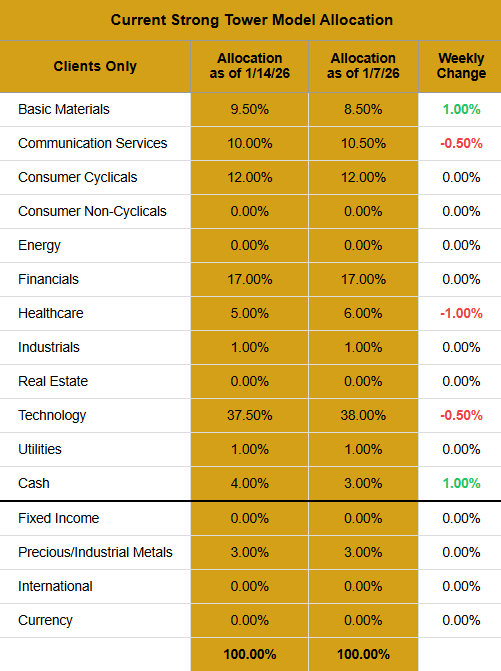
Current Strong Tower Model Allocation
Clients Only — Allocation as of 01/13/2026
Bottom Line:
50.00% of our model is in currently in the top 4 Industry Groups.
96.00% of our model is currently in the top 8 Industry Groups.
About Us
At Strong Tower Wealth Management, we offer comprehensive wealth management services using a goal-focused and holistic approach that considers each client’s overall financial situation, including their family, circumstances, and objectives. Our services include investment management, insurance planning, and estate planning coordination, provided with an emphasis on clarity and transparency.
Not a client yet? We invite you to schedule an introductory meeting with Brett to discuss your financial goals and learn more about how we can support you.
Brett Lewis
Founder / Managing Director
Strong Tower Wealth Management
www.strongtowerwealthmanagement.com