

Weekly Market Insight
Welcome to our weekly market update. This newsletter is designed to provide you with current market data, investment insights, and educational information about market trends and strategies. The content herein represents our observations and analysis of market conditions and is intended for informational and educational purposes only. It does not constitute personalized investment advice or a recommendation for any specific security or strategy.
Major Market Indexes
Closing Price as of 03/24/2026

The Strong Tower Difference
Ask Yourself…
What do you own?
Why do you own what you own?
Do you know what you’re truly paying for your investment management and advice?
If you can’t answer these three questions, watch this video
Items of Interest
Key Insights on Markets and Conflicts
1. Equities (Stocks):
Short-term: Often volatile, with sharp initial declines due to uncertainty.
Medium/long-term: Can rebound, especially in defense, infrastructure, and technology sectors.
Historical examples: WWII, Gulf War: markets recovered after initial shocks.
2. Government Bonds:
Typically act as a safe haven, lowering yields during conflict.
Inflationary pressures may rise in prolonged wars.
Historical examples: WWII, Middle East conflicts.
3. Commodities:
Oil & Energy: Prices often spike due to supply concerns.
Precious Metals: Gold and silver generally rise as hedges.
Agricultural Commodities: Volatility depends on conflict location and trade disruptions.
Historical examples: 1973 Oil Crisis, WWII gold demand.
4. Real Estate:
Usually stable or modestly declines in non-combat zones.
Government infrastructure projects can create localized growth.
Historical examples: London WWII, U.S. post-WWII reconstruction.
5. Currencies:
Safe havens: USD tends to strengthen.
Risk currencies: Those in combat zones or unstable regions may weaken.
Historical examples: USD during WWII.
6. Overall Observations:
Duration matters: Short wars typically cause limited disruption; long wars can reshape economies.
Policy impact: Government spending, taxation, and monetary actions influence asset returns.
Investor psychology: Fear and uncertainty often drive short-term volatility more than economic damage.
7. Volatility (VIX):
Tends to rise before U.S. military action and decline afterward as outcomes become clearer.
Suggests markets often “price in” conflict ahead of time.
8. Asset Class Performance:
Emerging markets and crude oil often show notable gains post-conflict.
Most other asset classes behave in line with historical expectations.
9. Context Over Fear:
Markets are forward-looking; declines are usually driven by uncertainty.
Historically, markets demonstrate resilience once outcomes are known.
Bottom Line:
Markets respond to uncertainty, not conflict itself.
Chart of Interest:
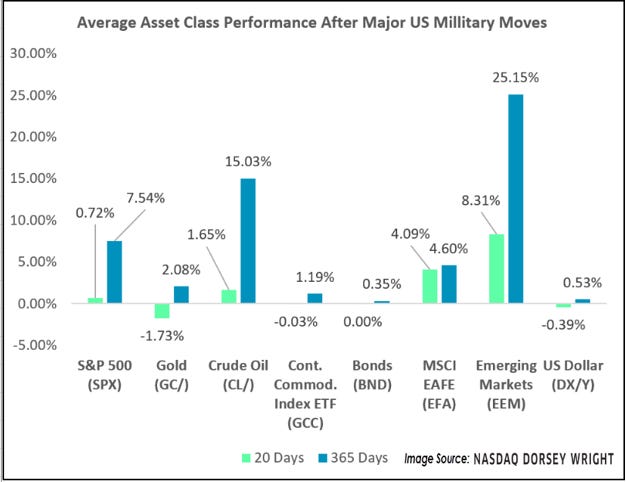
You Can’t Drive by Looking in the Rear-View Mirror
You can’t drive forward by looking in the rear-view mirror. While reviewing past market performance is useful, it should not dictate future decisions.
Investors should understand how their advisor plans to respond during the next market downturn. Markets are inherently unpredictable and can remain irrational for extended periods, which requires preparedness. It requires engagement and oversight. As the British economist, John Maynard Keynes said, “Markets can remain irrational longer than investors can remain solvent”, underscoring the importance of adaptability.
Like driving, there are times when conditions are clear and visibility is good. At other times, risks increases and conditions become more uncertain. While not all volatility can be anticipated, there are often observable indicators that warrant increased caution and adjustments. What is your advisor watching? Emotional reactions, such as exiting the market during downturns, can lead to missed recoveries. A common investor mistake. Overcorrecting in a curve, can wreck your vehicle and portfolio.
Strong Tower Wealth Management cannot predict market movements. However, portfolios are actively monitored and adjusted when market conditions change. This may include increasing cash allocations during periods of elevated volatility, providing flexibility and the ability to respond to opportunities. Or the best course of action is, no action at all.
Strong Tower does not follow a passive, static, “set it and forget it” allocation approach. Instead, we maintain a forward-looking, adaptive investment process that seeks to align portfolio positioning with changing market conditions.
A disciplined strategy involves adjusting exposure when conditions warrant, including raising cash to maintain flexibility. Effective investing requires ongoing evaluation, thoughtful adjustments and a commitment to staying focused on what lies ahead.
No strategy can guarantee outcomes. The focus remains on making informed, disciplined decisions and maintaining a proactive approach to portfolio management.
The “Other” March Madness
March often brings notable market volatility.
Historical examples include:
Last year, the S&P 500 dropped over 5.5% in March before rebounding sharply in April after tariffs were imposed.
Six years ago, it fell roughly 30% in March at the start of the COVID-19 pandemic.
This week marks 17 years since the Global Financial Crisis market bottom in March 2009.
Warnings from TV personalities like Jim Cramer, who was quoted on October 6, 2008, saying, “Whatever money you may need for the next five years, please take it out of the stock market right now, this week. I do not believe that you should risk those assets in the stock market right now.” Warnings like this, advising investors to pull money out of the market, helped some avoid further losses but many who exited completely missed the subsequent historic bull market, that began on March 9th, 2009. Similarly, panic-selling during the COVID crash led some investors to miss rapid recoveries. Anyone who shifted their entire portfolio to cash or bonds and maintained that long-term allocation did so to their detriment.
New Website!
Check out our new website!!
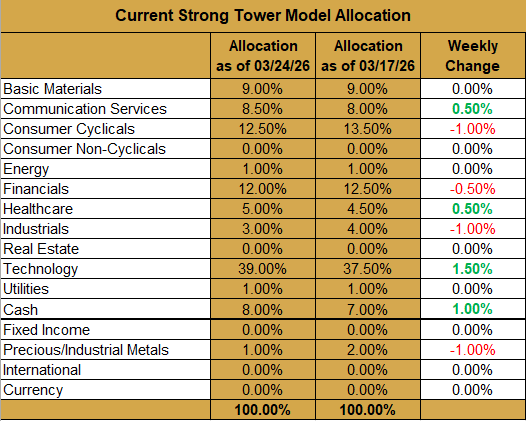
Current Strong Tower Model Allocation
Clients Only — Allocation as of 03/24/2026
Bottom Line:
54.00% of our model is currently in the top 4 Industry Groups.
91.00% of our model is currently in the top 8 Industry Groups.
About Us
At Strong Tower Wealth Management, we offer comprehensive wealth management services using a goal-focused and holistic approach that considers each client’s overall financial situation, including their family, circumstances, and objectives. Our services include investment management, insurance planning, and estate planning coordination, provided with an emphasis on clarity and transparency.
Not a client yet? We invite you to schedule an introductory assessment with Brett to discuss your financial goals and learn more about how we can support you.
Brett Lewis
Founder / Managing Director
Strong Tower Wealth Management
www.strongtowerwealthmanagement.com