

Weekly Market Insight
Welcome to our weekly market update. This newsletter is designed to provide you with current market data, investment insights, and educational information about market trends and strategies. The content herein represents our observations and analysis of market conditions and is intended for informational and educational purposes only. It does not constitute personalized investment advice or a recommendation for any specific security or strategy.
Major Market Indexes
Closing Price as of 03/31/2026

The Strong Tower Difference
Ask Yourself…
What do you own?
Why do you own what you own?
Do you know what you’re truly paying for your investment management and advice?
If you can’t answer these three questions, watch this video
Items of Interest
Question From a Client?
I am always appreciative and thankful for feedback and questions from clients and/or prospective clients. I thought this question was important enough to include in this week’s Newsletter and expand on more of the processes utilized here at Strong Tower Wealth Management (STWM).
“How long do we ride this downturn? Should we move to cash and re-enter when the market starts trending upward again?”
Great, great question! The short answer in most cases is no.
Market pullbacks, corrections, and periods of profit-taking are normal and healthy. Even spikes in the VIX (volatility index) are common. However, true capitulation and contagion represent a different and more serious environment.
Let’s take a closer look.
At STWM, we evaluate several key categories of data when assessing market conditions:
Fundamentals – The underlying health of companies, including earnings and revenue trends.
Technical Analysis – Support and resistance levels across individual securities, sectors, and the broader market.
Economic Data – Government reports, for example, such as CPI, PPI, and housing starts.
Geopolitical Factors – Domestic and international events that may impact markets.
Monetary Policy – Actions and guidance from the Federal Reserve.
These are among the most influential drivers of market behavior.
We’ve used this analogy before: when driving, how should you react if your car begins to skid? The correct response is to remain calm and gently steer into the skid, not to panic or overcorrect. And you certainly, don’t jump out of the car.
Markets behave similarly.
Often, when investors feel the strongest urge to “get out” and move to cash, markets are nearing a bottom or perhaps entering a consolidation phase. A period where prices move within a defined range. These periods can be important in establishing a base, and the longer they last, the more meaningful the eventual move, up or down, can be. If the market breaks higher, being overly defensive or in cash can result in missing a significant portion of the recovery before the trend becomes clear.
If markets move lower, that’s when capitulation and contagion risks may increase, and a more detailed evaluation becomes necessary.
This may involve:
Trimming or eliminating underperforming positions.
Reassessing sector exposure.
Identifying core holdings to retain during more challenging conditions.
A critical component of investing, often overlooked, is human behavior.
Behavioral finance studies how emotions and cognitive biases influence decision-making. Some of the most common include:
1) Loss Aversion: Losses tend to feel roughly twice as painful as gains feel rewarding.
2) Confirmation Bias: Seeking information that reinforces existing beliefs while ignoring opposing viewpoints.
3) Panic Selling: Selling during downturns out of fear, often associated with capitulation.
4) Fear of Missing Out (FOMO): Buying into rising markets to avoid missing gains, often near market peaks.
5) Herd Mentality: Following the crowd, which can amplify both market bubbles and declines.
6) Greed and Fear Cycle: Aggressive buying in strong markets and emotional selling in weak ones.
7) Irrational Exuberance: Overly optimistic, emotion-driven investing, commonly seen in market bubbles.
Bottom Line:
Markets are not driven solely by fundamentals, technical levels, economic data, geopolitical events, or Federal Reserve policy. They are also heavily influenced by investor sentiment and behavior. The most successful investors are not emotionless. They simply have disciplined processes in place to manage those emotions. Whether through a structured system or an actively engaged advisor, consistency and execution are key differentiators.
So, when markets enter a “skid,” our objective is to make measured adjustments, not overreactions. And we certainly don’t jump out of the car.
New Website!
Check out our new website!!
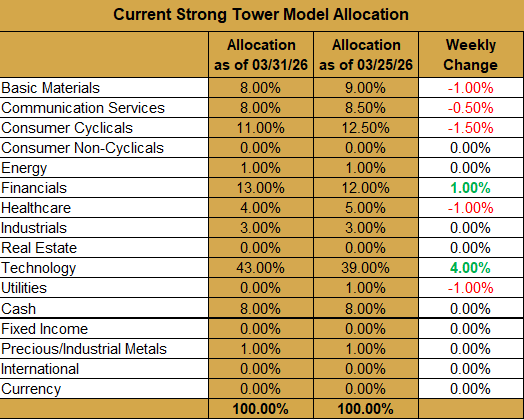
Current Strong Tower Model Allocation
Clients Only — Allocation as of 03/31/2026
Bottom Line:
58.00% of our model is currently in the top 4 Industry Groups.
92.00% of our model is currently in the top 8 Industry Groups.
About Us
At Strong Tower Wealth Management, we offer comprehensive wealth management services using a goal-focused and holistic approach that considers each client’s overall financial situation, including their family, circumstances, and objectives. Our services include investment management, insurance planning, and estate planning coordination, provided with an emphasis on clarity and transparency.
Not a client yet? We invite you to schedule an introductory assessment with Brett to discuss your financial goals and learn more about how we can support you.
Brett Lewis
Founder / Managing Director
Strong Tower Wealth Management
www.strongtowerwealthmanagement.com