

Weekly Market Insight
Welcome to our weekly market update. This newsletter is designed to provide you with current market data, investment insights, and educational information about market trends and strategies. The content herein represents our observations and analysis of market conditions and is intended for informational and educational purposes only. It does not constitute personalized investment advice or a recommendation for any specific security or strategy.
Major Market Indexes
Closing Price as of 01/20/2026

The Strong Tower Difference
Ask Yourself…
What do you own?
Why do you own what you own?
Do you know what you’re truly paying for your investment management and advice?
If you can’t answer these three questions, watch this video.
3. Do You Know What You're Truly Paying for Your Investment Management and advice?
During extended periods of strong and resilient market performance, the impact of investment management and advisory fees may not always be top of mind. However, fee awareness becomes increasingly important during periods of market stress or prolonged downturns. Over time, even seemingly modest differences in fees, such as an additional 1% annually, can materially affect portfolio growth. When compounded over many years, higher fees may result in meaningfully lower investable assets and reduced long-term outcomes.
Let’s talk about the typically internal and external fees with most investment accounts, particularly within mutual fund portfolios.
Current Items of Interest
Internal and External Management Fees
Mutual fund costs generally fall into two categories: internal expense fees and external management fees, both of which affect an investor’s overall return.
Internal expense fees (expense ratio) are built into the mutual fund and deducted directly from fund assets. These fees cover portfolio management, day-to-day operations, recordkeeping, compliance, custodial services, transfer agent services, and, if applicable, distribution or marketing costs such as 12b-1 fees. Because they are deducted internally, investors do not receive a separate bill, but these costs reduce performance over time.
External management fees are charged separately by an advisor or investment firm for managing an investor’s overall portfolio. These fees typically compensate the advisor for asset allocation, investment selection, monitoring, rebalancing, risk management, and financial planning services. External fees are usually assessed as a percentage of assets under management and billed periodically to the investor, not deducted from the mutual fund.
Why it matters:
Investors working with an advisor may pay both internal and external fees, making it important to evaluate costs on an “all-in” basis. Even modest fee differences can have a meaningful impact on long-term results.
Key takeaway:
Internal fees pay for the operation and management of the mutual fund itself, while external management fees pay for personalized advice and portfolio-level oversight. Understanding both provides a clearer picture of the true cost of investing.
STWM only charges an external fee for our investment management, oversight, and planning.
The January Barometer
The January Barometer suggests that the stock market’s performance in January sets the tone for the rest of the year:
If the market finishes up in January, the full year is more likely to end positive
If January is down, the odds of a weaker or negative year increase
The average return for years starting with a positive January is +16.9% for the year.
The average return for years starting with a negative January is -1.74%.
The concept was popularized by the Stock Trader’s Almanac, which tracked that historically, when January was positive, the S&P 500 finished the year higher, a majority of the time.
The fine print…
It’s a market tendency, not a rule.
January can be heavily influenced by:
Year-end tax positioning.
Institutional rebalancing.
New capital flows at the start of the year.
There have been plenty of exceptions (strong Januarys followed by weak years, and vice versa).
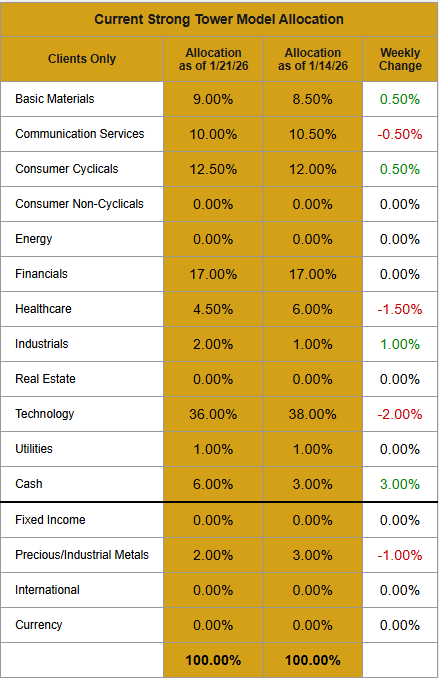
Current Strong Tower Model Allocation
Clients Only — Allocation as of 01/20/2026
Bottom Line:
50.00% of our model is in currently in the top 4 Industry Groups.
94.00% of our model is currently in the top 8 Industry Groups.
About Us
At Strong Tower Wealth Management, we offer comprehensive wealth management services using a goal-focused and holistic approach that considers each client’s overall financial situation, including their family, circumstances, and objectives. Our services include investment management, insurance planning, and estate planning coordination, provided with an emphasis on clarity and transparency.
Not a client yet? We invite you to schedule an introductory meeting with Brett to discuss your financial goals and learn more about how we can support you.
Brett Lewis
Founder / Managing Director
Strong Tower Wealth Management
www.strongtowerwealthmanagement.com