

Weekly Market Insight
Welcome to our weekly market update. This newsletter is designed to provide you with current market data, investment insights, and educational information about market trends and strategies. The content herein represents our observations and analysis of market conditions and is intended for informational and educational purposes only. It does not constitute personalized investment advice or a recommendation for any specific security or strategy.
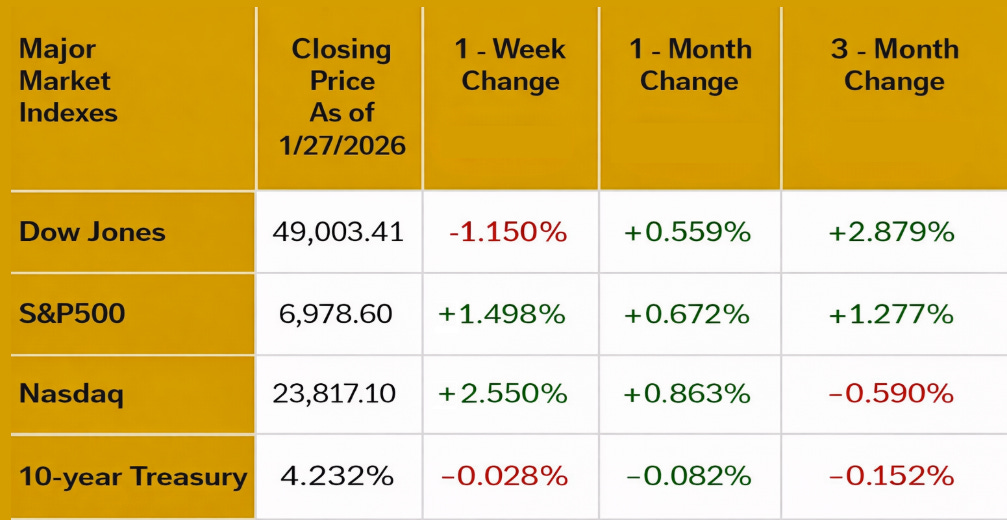
Major Market Indexes
Closing Price as of 01/27/2026
The Strong Tower Difference
Ask Yourself…
What do you own?
Why do you own what you own?
Do you know what you’re truly paying for your investment management and advice?
If you can’t answer these three questions, watch this video.
Current Items of Interest
2025 Market Performance Summary
U.S. equity markets posted solid gains in 2025, with all three major indexes finishing the year higher.
Dow Jones +13.0%
S&P 500 +16.4%
Nasdaq +20.4%
(Reuters)
Performance was supported by continued economic growth, resilient corporate earnings, and easing inflation pressures, though market volatility was persistent. During the fourth quarter of 2025, all three indexes generated positive returns, contributing to full-year performance but at a slower pace than earlier in the year. While market returns in 2025 were positive, results varied by sector and investment style.
It is this last point that I will provide further comment on: “Results varied by sector and investment style….”
What is Sector Dispersion?
Dispersion refers to the spread of returns across individual stocks, sectors, or asset classes within the market.
High dispersion = big differences between winners and losers.
Low dispersion = most stocks moving together.
Why it matters:
When dispersion is high, active management and security selection tend to have more opportunity, because performance differences are wider. When dispersion is low, index-like or passive approaches often look better since everything is moving together.
Divergence can signal:
Narrow leadership
Changing market dynamics
Potential trend changes or increased volatility
The gap between the strongest and weakest areas of the market, has historically been wide. This dispersion creates opportunities for disciplined, relative strength-based sector allocation strategies to add value beyond traditional buy-and-hold approaches. Long-term analysis demonstrates that allocating toward stronger sectors has historically had a greater impact on outcomes than perfectly timing the overall market, reinforcing the importance of sector rotation within a diversified portfolio.
Diversification and disciplined investment strategies remain important, regardless of market environment.
Bottom Line:
Back to one of our original three questions.
2. Why Do You Own, What You Own?
With wide spreads on the performance between the strongest and weakest performing investments in your allocation, why do you own then? Maybe it’s time for you to check with STWM and see where your investments fall within our Relative Strength strategy?
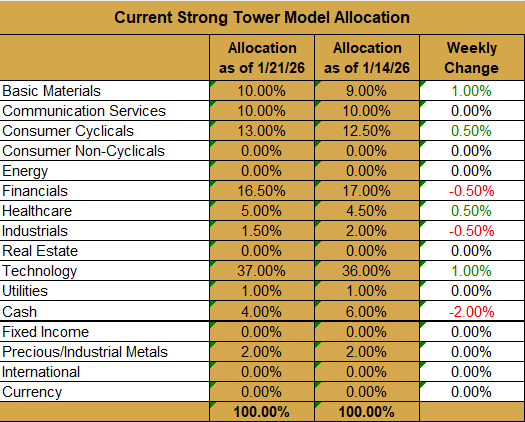
Current Strong Tower Model Allocation
Clients Only — Allocation as of 01/27/2026
Bottom Line:
49.00% of our model is in currently in the top 4 Industry Groups.
96.00% of our model is currently in the top 8 Industry Groups.
About Us
At Strong Tower Wealth Management, we offer comprehensive wealth management services using a goal-focused and holistic approach that considers each client’s overall financial situation, including their family, circumstances, and objectives. Our services include investment management, insurance planning, and estate planning coordination, provided with an emphasis on clarity and transparency.
Not a client yet? We invite you to schedule an introductory assessment with Brett to discuss your financial goals and learn more about how we can support you.
Brett Lewis
Founder / Managing Director
Strong Tower Wealth Management
www.strongtowerwealthmanagement.com