

Weekly Market Insight
Welcome to our weekly market update. This newsletter is designed to provide you with current market data, investment insights, and educational information about market trends and strategies. The content herein represents our observations and analysis of market conditions and is intended for informational and educational purposes only. It does not constitute personalized investment advice or a recommendation for any specific security or strategy.
Major Market Indexes
Closing Price as of 09/30/2026

The Strong Tower Difference
Ask Yourself…
What do you own?
Why do you own what you own?
Do you know what you’re truly paying for your investment management and advice?
If you can’t answer these three questions, watch this video
Items of Interest
Here Comes October….......
Historically, October has a much worse reputation than its actual average return would suggest. The reason is Volatility. Several of the most memorable market crashes occurred in October, even though the month has historically produced a modestly positive average return.
Using long-term S&P 500 data shows that October has been positive about 57% of the time, with an overall average gain of roughly +0.46%. In positive Octobers, the average gain has been about +4.18%; in negative Octobers, the average decline has been about −4.67%. (S&P Global)
Why October has such a bad reputation:
Three historic episodes dominate investors’ memories: the 1929 crash, Black Monday in October 1987, and the extreme volatility surrounding the 2008 financial crisis. These extreme volatility events make October feel considerably worse than its long-term averages indicate.
There’s also an important seasonal transition occurring. October is essentially the bridge between the historically weaker May–October period and the stronger November–April period. Since 1950, the S&P 500 has averaged only about 1.8% from May through October, while the period beginning in November has historically been considerably stronger. (LPL Financial)
The important distinction: Return vs. Volatility
October isn’t historically a terrible month for returns. It is historically an unusually volatile month. In other words, October can be rough even when the final monthly result is relatively ordinary. Large intramonth declines, sharp rallies and ±1% days have historically occurred more frequently during October. And October can produce substantial upside as well. For example, the S&P 500 gained 7.99% in October 2022, despite that year being an exceptionally difficult environment for equities. (S&P Global)
October also begins a historically stronger stretch:
Perhaps the more significant seasonal statistic is what happens after September. Since 1950, the S&P 500 has historically gained about 4.2% from October through December, with approximately 80% of those three-month periods finishing positive. (LPL Financial)
September → Historically weak
October → Volatile, but modestly positive on average
November–December → Historically stronger
Bottom Line:
“Volatility Does Not Necessarily Mean Weakness.”
October is a good example of why reacting to volatility alone can be misleading: Historically, it’s been a turbulent month, but it also marks the beginning of one of the market’s stronger seasonal periods.
Seasonality is descriptive rather than predictive; earnings, rates, economic conditions, and geopolitics can overwhelm the historical pattern in any individual year.
Last 7 Days.
Over the last seven days, the dominant market story has been the uncertainty between higher interest rates, Middle East energy risk, and continued strength in technology/AI stocks.
Treasury yields surged. The 10-year Treasury moved from roughly 4.96% on Sept. 22 to above 5.2%, reaching levels not seen since 2007. Higher oil prices, inflation concerns and expectations that the Federal Reserve may keep policy tighter, have put pressure on bonds and equity valuations. (Federal Reserve)
Stocks have been surprisingly resilient. On Sept. 24, the S&P 500 finished essentially flat at 7,704, despite sharply higher yields. Stocks rebounded Sept. 25, with the Dow gaining about 0.9% and the S&P 500/Nasdaq roughly 0.5%. But renewed geopolitical concerns pushed the S&P 500 down 0.8% Monday, Sept. 28. (AP News)
Technology/AI remains a major source of support. Continued enthusiasm around AI-related companies helped offset some of the pressure from rising rates, particularly late last week. (Kitco)
Middle East/Iran remains the biggest geopolitical market risk. Uncertainty surrounding the conflict and the Strait of Hormuz has kept oil elevated and volatile. Reports of negotiations temporarily helped stocks and oil, but renewed uncertainty pushed WTI back toward the mid-$90s Monday. (Schwab Brokerage)
Russia/Ukraine tensions remain elevated. Russia continued strikes against Ukrainian infrastructure and ports, while European defense ministers met Monday with air defense and continued military assistance to Ukraine among their priorities. (Consilium)
U.S.–China tensions eased somewhat. Following the Trump-Xi meetings, the countries announced reciprocal lists covering roughly $30 billion of goods each that could receive reduced tariff treatment. However, larger disputes involving technology, rare earths, Taiwan, and strategic competition remain unresolved. (The White House)
Market reaction: Investors appear to be treating geopolitics primarily through the oil → inflation → interest-rate channel. Higher oil increases inflation concerns, which pushes Treasury yields higher and puts pressure on equity valuations. At the same time, strong AI/technology momentum has kept the broader market from experiencing a larger correction.
Bottom Line:
Markets remain strong but increasingly volatile. Rising Treasury yields and oil prices are key risks, while easing geopolitical tensions and lower energy prices could provide support for stocks.
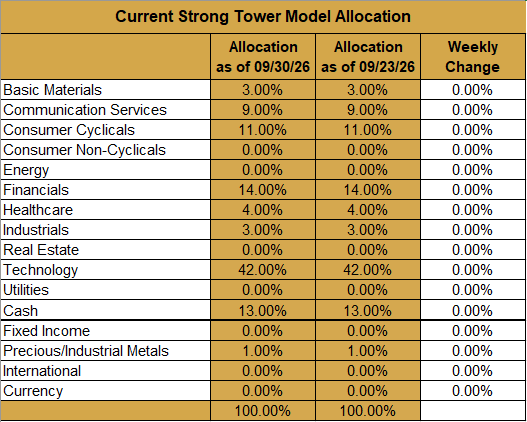
Current Strong Tower Model Allocation
Clients Only — Allocation as of 09/30/2026
Bottom Line:
61% of our model is currently in the top 4 Industry Groups.
68% of our model is currently in the top 8 Industry Groups.
About Us
At Strong Tower Wealth Management, we offer comprehensive wealth management services using a goal-focused and holistic approach that considers each client’s overall financial situation, including their family, circumstances, and objectives. Our services include investment management, insurance planning, and estate planning coordination, provided with an emphasis on clarity and transparency.
Not a client yet? We invite you to schedule an introductory assessment with Brett to discuss your financial goals and learn more about how we can support you.
Brett Lewis
Founder / Managing Director
Strong Tower Wealth Management
www.strongtowerwealthmanagement.com