

Weekly Market Insight
Welcome to our weekly market update. This newsletter is designed to provide you with current market data, investment insights, and educational information about market trends and strategies. The content herein represents our observations and analysis of market conditions and is intended for informational and educational purposes only. It does not constitute personalized investment advice or a recommendation for any specific security or strategy.
Major Market Indexes
Closing Price as of 11/10/2026

The Strong Tower Difference
Ask Yourself…
What do you own?
Why do you own what you own?
Do you know what you’re truly paying for your investment management and advice?
If you can’t answer these three questions, watch this video
Items of Interest
My Cousin Vinny!
The Stock Market Just Can’t Get Any Traction!
In the classic comedy, (and one of my favorite movies), My Cousin Vinny, there’s a memorable scene where Vinny’s car gets stuck in the Alabama mud. No matter how hard he presses the accelerator, the tires keep spinning, the mud keeps flying, and the car goes nowhere.
Sound familiar?
That’s a great analogy for the stock market over the past several months. Investors have watched repeated rallies gain momentum, only to lose traction as inflation concerns, interest-rate uncertainty, geopolitical tensions, and elevated technology valuations weigh on consumer sentiment. Just when the market appears ready to break higher, another obstacle sends it back into its trading range.
All indications point to the fact the market has plenty of horsepower, but it just can’t seem to find solid ground.
Much like Vinny’s car, spinning the wheels creates plenty of noise and activity, but very little forward progress. Until buyers demonstrate enough conviction to push the major indexes decisively above resistance, investors may continue experiencing a frustrating cycle of rallies and pullbacks.
The analogy is particularly appropriate given the S&P 500’s nearly three-month trading range, despite occasional record highs and sharp rebounds. Morgan Stanley’s November commentary similarly described a market struggling with AI valuations, rising interest rates, inflation, and geopolitical uncertainty. (E*Trade).
The lesson? Sometimes the market doesn’t need more horsepower, it just needs better traction. Stronger market breadth, improving earnings, and renewed investor confidence could provide the traction necessary for a sustainable breakout. Until then, patience, discipline, and attention to relative strength remain important.
Odds & Ends
Market Seasonality: November - April
Historically, the November through April period represents the strongest six-month stretch for U.S. equities, often referred to as the market’s Best Six Months. This seasonal pattern has generally produced stronger returns than the May–October period, supported by year-end investment flows, improving investor sentiment, and early-year market momentum.
While historical seasonality favors equities during this period, economic conditions, interest rates, geopolitical developments, and market trends ultimately determine performance. Seasonality provides a favorable historical backdrop but does not guarantee positive returns.
Historical data since 1950 shows the S&P 500 has averaged approximately 7% during November–April, compared with roughly 2% during May–October, with positive returns in about 76% of the stronger six-month periods.
However, the seasonal advantage has narrowed in some recent years, reinforcing the importance of following market trends rather than relying on the calendar alone. (ChartingLens).
Historical Stock Market Performance: Midterm Elections & Divided Government
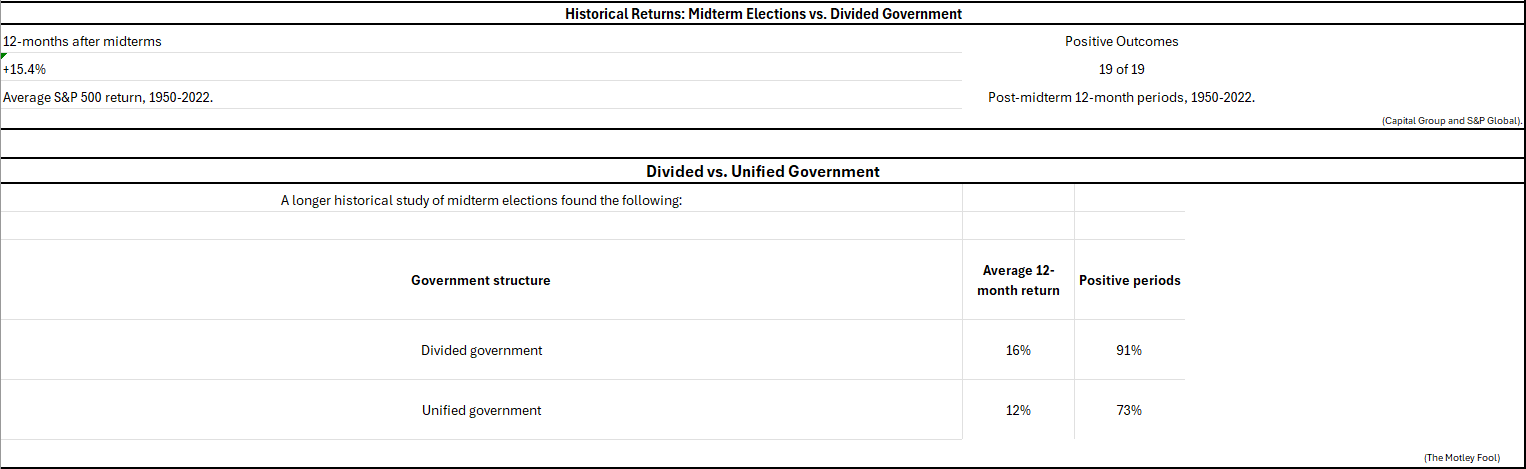
Historically, U.S. stock markets have performed particularly well following midterm elections, especially when the election produces divided government, where the presidency and at least one chamber of Congress are controlled by opposing political parties.
Three historical trends stand out:
1) Post-midterm strength: The S&P 500 has historically averaged approximately 15%–16% in the 12 months following midterm elections, with positive returns in every such period from 1950 through 2022.
2) Divided government: Stocks have historically generated positive long-term returns under both unified and divided government. Divided government can reduce the likelihood of major legislative changes, potentially providing greater policy predictability.
3) Political gridlock: Investors sometimes view gridlock favorably because it may limit significant changes to taxation, regulation, and government spending. However, budget disputes and debt-ceiling negotiations can create uncertainty.
Historical Perspective for 2026
The historical tendency toward stronger post-midterm returns provides a constructive backdrop following the November 2026 elections. However, divided government does not necessarily cause stronger stock returns. Economic growth, corporate earnings, inflation, and Federal Reserve policy remain more important long-term influences. (U.S. Bank).
Bottom Line:
Historically, the stock market has performed strongly following midterm elections, with the S&P 500 averaging approximately 15% over the subsequent 12 months since 1950. Divided government has also coincided with favorable market returns, potentially reflecting greater policy stability and reduced legislative uncertainty. While these historical trends provide an encouraging backdrop, economic fundamentals and prevailing market trends remain the primary drivers of future performance.
A Democratic-controlled Congress could create near-term volatility for AI stocks by increasing regulatory scrutiny, potentially raising infrastructure costs, and challenging the pace of AI expansion. However, the longer-term outlook remains tied to AI adoption, corporate profitability, and continued technology investment.
Five Potential Impacts on AI Investments
1) Increased AI regulation
2) Data Center Restrictions
3) Semiconductor Export Controls
4) Greater Anti-Trust Scrutiny
5) Political Gridlock
What Could This Mean for AI Stocks?
Near term: Increased uncertainty surrounding regulation and capital expenditures could contribute to volatility, particularly among highly valued AI companies. Intermediate term: Higher data center operating costs and restrictions on development could pressure profitability and delay infrastructure projects. Long term: AI adoption could continue expanding despite additional regulation. Companies demonstrating sustainable earnings growth, improving productivity, and positive returns on AI investments may be better positioned to withstand policy uncertainty.
An important distinction is that Congressional oversight can increase without new legislation becoming law. Presidential veto power and Senate procedural requirements could limit major regulatory changes.
Ultimately, AI’s longer-term market performance will likely depend more on corporate earnings, capital investment returns, and sustained demand than political developments alone. The potential risk is not necessarily a decline in AI adoption, but whether increased costs and regulatory uncertainty could cause AI-related stock valuations to adjust faster than underlying earnings growth.
Simply put…...back to the basics.
Last 7 Days.
Stock Market Highlights
Stocks rebound sharply: U.S. equities recovered much of last week’s losses on November 9. The S&P 500 surged 2.35%, the Dow gained 1,104 points (+2.15%), and the Nasdaq advanced 2.74%, supported by falling oil prices. (MarketScreener).
AI stocks experience significant volatility: Concerns about excessive AI infrastructure spending, elevated valuations, and potential restrictions on data-center development triggered a technology selloff. The Nasdaq fell 5.5% on November 5 alone. (Yahoo Finance).
Midterm elections reshape market expectations: Democratic victories in Congress increased uncertainty surrounding tariffs, AI infrastructure, energy policy, and regulation. Healthcare, homebuilding, and consumer-related companies attracted renewed interest. (AP News).
Federal Reserve rate-hike expectations increase: October employment rose by 165,000 jobs, exceeding expectations. Markets are pricing an approximately 84% probability of a December rate increase as inflation remains a concern. (MarketScreener).
Treasury yields remain elevated: The 10-year Treasury yield finished November 9 near 4.87%, although below October’s peak above 5.30%. Investors await the November 10 CPI report for further direction. (MarketScreener).
Geopolitical Highlights
Iran conflict and oil prices: Expectations for renewed negotiations reduced fears of further U.S. military strikes against Iran. Brent crude fell nearly 6% on November 9 to $92.57 per barrel, easing some inflation concerns. However, shipping disruptions around the Strait of Hormuz remain a significant risk. (MarketScreener).
Russia–Ukraine peace negotiations: U.S.-mediated discussions began November 10 in Abu Dhabi, focusing on security guarantees, humanitarian issues, and potential de-escalation. Russia continued attacks against Ukrainian infrastructure ahead of negotiations. (Europe live).
China and U.S. technology tensions: Nvidia faces additional scrutiny following allegations involving potential Chinese intelligence activity. The company stated it has no reason to believe national security or proprietary information was compromised. (Chron).
Global energy uncertainty persists: Despite declining crude prices, the Iran conflict and ongoing attacks on Ukrainian energy infrastructure continue to threaten global energy supplies and inflation stability. (MarketScreener).
Bottom Line:
Markets have rebounded on easing geopolitical tensions and falling oil prices, but inflation, interest-rate uncertainty, and elevated technology valuations remain risky. Broader market participation will be key to sustaining the recovery.
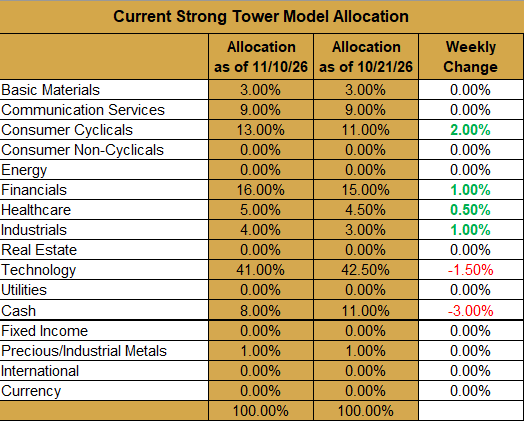
Current Strong Tower Model Allocation
Clients Only — Allocation as of 11/10/2026
Bottom Line:
19.00% of our model is currently in the top 4 Industry Groups.
84.00% of our model is currently in the top 8 Industry Groups.
About Us
At Strong Tower Wealth Management, we offer comprehensive wealth management services using a goal-focused and holistic approach that considers each client’s overall financial situation, including their family, circumstances, and objectives. Our services include investment management, insurance planning, and estate planning coordination, provided with an emphasis on clarity and transparency.
Not a client yet? We invite you to schedule an introductory assessment with Brett to discuss your financial goals and learn more about how we can support you.
Brett Lewis
Founder / Managing Director
Strong Tower Wealth Management
www.strongtowerwealthmanagement.com