

Weekly Market Insight
Welcome to our weekly market update. This newsletter is designed to provide you with current market data, investment insights, and educational information about market trends and strategies. The content herein represents our observations and analysis of market conditions and is intended for informational and educational purposes only. It does not constitute personalized investment advice or a recommendation for any specific security or strategy.
Major Market Indexes
Closing Price as of 04/14/2026

The Strong Tower Difference
Ask Yourself…
What do you own?
Why do you own what you own?
Do you know what you’re truly paying for your investment management and advice?
If you can’t answer these three questions, watch this video
Items of Interest
As a reminder, at Strong Tower, we utilize both fundamental and technical data in the management of our clients’ portfolios. We use the services of Dorsey Wright & Associates, for some of our research, charting, market commentary and thought leadership. On that note, there was a great article this past week regarding the Masters. I would like to share that article with you.
A Lesson from Azelea: It’s Never All Roses
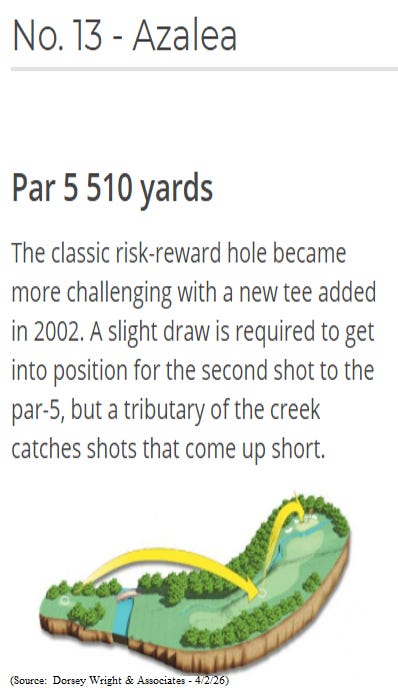
(Source: Dorsey Wright & Associates - 4/2/26)
If the 13th hole at ANGC, home of the Masters, isn’t the perfect golf hole, it is close. If it isn’t the most strategic hole at ANGC, it is close. And if a hole that is aptly named “Azalea” isn’t the most scenic on the golf course come early April each year, you need to have a long talk with the course superintendent. ANGC is unique as a golf course in many ways, and this is the time of year that avid golf fans can do a little more than just sit back and watch in awe. The par 5’s at Augusta, of which the 13th hole is one, are among the easiest holes on the course based upon scoring averages, and they are often the only holes that play under par. The 12th hole, by contrast, is the shortest hole on the course (listed at 155 yards) and is typically played over par by “the field.” In fact, the historical stroke average for this hole is above par at 3.27. It is sometimes among the most difficult holes on the course relative to par. But it is that first step off the slippery 12th green that concerns us today and will concern the best golfers in the world later this week, as this is when they head up to the final hole of what is affectionately referred to as “Amen Corner,” the aforementioned 13th.
In terms of coming in under par, the 13th at Augusta is among the “easiest” holes, if not the easiest, on the course, historically speaking. On average, the scoring on the 13th is under par at 4.77. But that doesn’t mean there aren’t some scary moments for the pros. When players get to the 13th at Augusta in today’s composite-fused, over-sized, extra-long, super-stiff, NASA-approved driver world, it isn’t the length of the hole that is daunting - almost every player in the field is capable of reaching the 510ish yard par-5 in two strokes. Rather, it is the combination of distance, a steeply sloping fairway, enough pine straw to choke a rake, and the most famous creek in golf (Rae’s) protecting a green that makes the Rockies look flat, that makes the 13th one of the most strategic holes in golf.
On the one hand, the green is easily reachable in two for a scratch golfer (distance-wise), if played well. On the other hand, some of the best golfers in the world have putted a ball off the green and into the creek (Tiger Woods in 2005). Before putting comes into play, a good tee shot is mandatory for a golfer to even think about the aggressive second shot that could ultimately lead to an eagle on the 13th. A wayward drive that lands in the trees or the pine needles makes going for the green a treacherous proposition with a low probability for success (just don’t tell Phil Mickelson). And even with a good tee shot, the second shot is one of pure strategy, a point-driven home like a John Daly slap-shot back in 2007. That same year, Tiger Woods had a remarkable eagle at 13 in the final round after hitting the green in two and caused perhaps the loudest roars of the tournament that year. Meanwhile, the eventual winner, Zach Johnson, chose not to attempt to reach the green in two shots a single time in the tournament, and as the sunset on Master’s Sunday, he was the one slipping on a new green blazer. Or who could forget when Bubba Watson, back in 2014, went on to claim his second green jacket after gaining plenty of momentum on 13. He blasted his drive over the trees and onto the fairway, then pulled out a sand wedge to plop it over Rae’s Creek and onto the green in two. He then birdied the hole. As you can see, number 13 at Augusta is quite simply a remarkable risk-reward hole that offers many ways to play it and many ways to fail.
Who’s Your Caddie??
At STWM, we utilize several types of research services to provide data analytics. We focus on fundamentally strong companies and sectors and use technical analysis to determine support and resistance levels, entry and exit points, to name a few. So, a fair comparison is: our research is our “caddie”. A caddie’s role is to support the golfer in making informed decisions and managing the course effectively.
Their responsibilities include but are not limited to:
Course management and strategy - Helps the player evaluate each shot (what is the “lie” of the ball? More on this later), considering distance, hazards, wind, terrain and overall strategy. They often recommend which club to use and the best approach to the hole.
Reading greens - On the putting surface, caddies assist in reading slopes, speed and break to help the golfer judge how a putt will roll.
Carrying and maintaining equipment - They carry the golf bag, keep clubs clean, managed yardage tools, and ensure everything is ready for each shot.
Providing perspective and composure - A good caddie helps the player stay focused and emotionally steady, especially after poor shots or during high-pressure moments.
Course knowledge - Experienced caddies bring valuable insight into the course layout, conditions and tendencies that may not be obvious to the player.
In short, a caddie acts as a combination of strategist, advisor and support system, helping the golfer make better decisions while the player ultimately executes each shot.
The “lie” refers to the position and condition of the golf ball at rest, and how it sits relative to the ground or surrounding environment.
Key aspects of a “lie”:
Surface – Is the ball in the fairway, rough, sand bunker, or another area?
Ball position – Is it sitting cleanly on top of the grass, buried, or uneven?
Surroundings – Are there obstacles like trees, slopes, or hazards affecting the swing?
Why it matters:
The “lie” directly influences club selection, shot type, and expectations for the outcome. A skilled golfer adjusts their strategy based on the lie rather than forcing an ideal shot. In simple terms, the “lie” is the reality of the situation you must play from, and the foundation for your next decision.
How does you or your current advisor determine the “lie” of the ball?
Do you know?
This market comment uses a golf analogy to explain how investors should approach uncertain markets.
The key message: Don’t abandon your strategy when conditions get difficult. Stay focused on fundamentals and make disciplined decisions based on current conditions.
Markets today are mixed:
The S&P 500 is coming off strong performance but has recently stumbled.
Leadership (like technology) has cooled in the short term.
Some sectors are still performing well.
External risks (like geopolitical tensions and energy prices) add uncertainty.
Like facing a tough second shot in golf, investors aren’t dealing with a perfect setup, but there are still multiple reasonable paths forward. The goal isn’t perfection (an “eagle”), but solid outcomes (a “par” or “birdie”) given the situation.
At STWM, we utilize several research and information sources to evaluate the “lie” of the markets.
They provide us with guidance and perspective.
They help us evaluate probabilities and conditions
Bottom Line:
Successful investing, like good golf, comes from discipline, preparation, and consistent decision-making, not waiting for ideal conditions or reacting emotionally to setbacks. Market environments are rarely “ideal,” and waiting for complete clarity may result in missed opportunities. Instead, a consistent, process-driven approach, supported by analytical tools and a relative strength strategy, can help make informed decisions under a variety of market conditions. Ultimately, success in investing, is framed as a function of discipline, prudent risk management, and adherence to a well-defined methodology, rather than short-term market timing or emotional reactions.
New Website!
Check out our new website!!
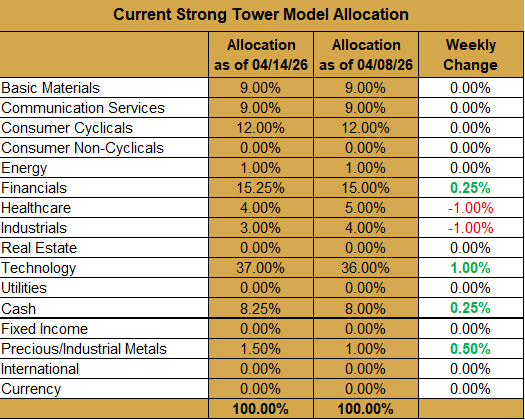
Current Strong Tower Model Allocation
Clients Only — Allocation as of 04/14/2026
Bottom Line:
52.00% of our model is currently in the top 4 Industry Groups.
91.00% of our model is currently in the top 8 Industry Groups.
About Us
At Strong Tower Wealth Management, we offer comprehensive wealth management services using a goal-focused and holistic approach that considers each client’s overall financial situation, including their family, circumstances, and objectives. Our services include investment management, insurance planning, and estate planning coordination, provided with an emphasis on clarity and transparency.
Not a client yet? We invite you to schedule an introductory assessment with Brett to discuss your financial goals and learn more about how we can support you.
Brett Lewis
Founder / Managing Director
Strong Tower Wealth Management
www.strongtowerwealthmanagement.com